
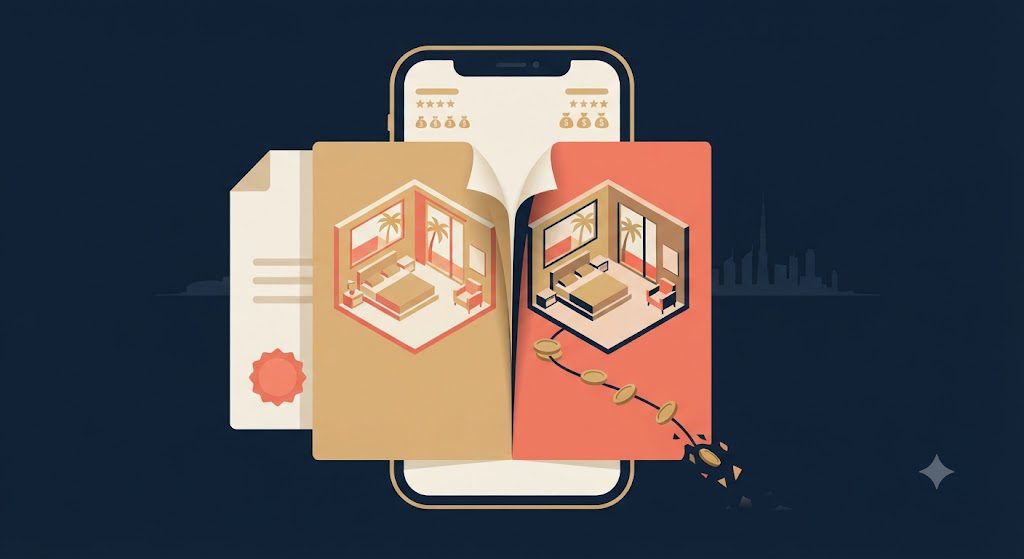
The photos can be real. The apartment can be real. The person taking your money can still have nothing to do with either of them.
That is what makes the current Dubai holiday-home scam effective. On June 6, 2026, Dubai Police warned residents after a man lost AED 8,000 to a fake chalet advertisement. He paid a booking deposit and a supposedly refundable insurance fee. After the transfer, the advertiser switched off the phone and disappeared. Police said they had received several similar reports.
The old version of this article reduced the solution to one rule: never pay before viewing. That is too simple. People legitimately book holiday homes online every day without first walking through the property. The safer question is whether the listing, operator, permit, payment route, and booking record all connect to the same real accommodation.
| T H E R O B I U S V E R D I C T SCAM: Fake holiday-home listings are an active fraud pattern in the UAE. Dubai Police says scammers reuse genuine property photos, advertise unusually cheap stays, create urgency, and collect deposits or ‘refundable’ fees for properties they do not control.A deposit by itself is not proof of fraud. The red flag is a payment request that cannot be tied to a verified booking, a legitimate operator or owner, and a permitted holiday-home unit. |
What Dubai Police Actually Warned About
The June warning was specific. A resident found an attractive chalet offer online, contacted the advertiser, and was asked to pay a deposit plus an insurance amount said to be refundable. He transferred AED 8,000. The advertiser then became unreachable.
Dubai Police said this was not an isolated complaint. The pattern involved fraudsters copying photographs and details from genuine chalet or holiday-home advertisements, reposting them at unusually low prices, and then pushing interested renters to transfer money quickly.
The key point is not that the property always turns out to be imaginary. Sometimes the property exists and the photographs are genuine. The fraud is that the person advertising it has no right to rent it to you.
A month later, Dubai Police issued another summer-travel warning about fake travel agencies, hotel stays, and booking sites. The same mechanics appeared again: unusually cheap offers, cloned branding, urgent payment requests, personal or unknown bank accounts, and bookings that never existed.
The Old ‘Never Pay Before Viewing’ Rule Is Too Blunt
Dubai Police did advise people to inspect and verify a property before transferring money, and an in-person visit can be useful when you are dealing directly with an owner or operator. But a physical viewing is not the only way a legitimate holiday-home booking works.
A family booking a weekend apartment through a major platform may never see the unit until check-in. A guest coming from overseas obviously cannot inspect it first. Legitimate operators can also collect security deposits before arrival. DET’s current Holiday Homes User Guide expressly allows a licensee to obtain a security deposit before a guest moves into the property, provided the deposit is handled and accounted for properly.
So the presence of a deposit does not tell you whether the booking is genuine. The surrounding evidence does.
Check 1: Verify That the Unit Is Actually a Dubai Holiday Home
Dubai does not treat short-term rentals as an informal side business. The Department of Economy and Tourism regulates holiday homes. DET’s current service page says apartments and villas must be registered and approved before they are listed.
Under Dubai’s holiday-home framework, a permit is issued for the unit after the required conditions are met. The current DET guide also says an individual owner can apply for permits for their own units, while operators managing holiday homes for others require the appropriate business setup.
That means a legitimate-looking social media profile is not enough. Ask the seller which legal operator or owner is responsible for the booking and for the holiday-home permit. The names on the invoice, payment request, booking confirmation, and operator details should make sense together.
Do not rely on a screenshot of a permit sent over WhatsApp. Ask for the permit/operator details and verify them through official DET channels or the platform through which you are booking.
Check 2: Start From the Real Platform, Not the Link You Were Sent
A scammer can clone a listing page, copy a logo, or send you a payment link that looks almost identical to a genuine booking service.
Open the booking platform yourself. Search for the property independently. If you found the offer on Instagram, Facebook, TikTok, or WhatsApp, try to find the same operator and unit through a trusted booking channel or the operator’s official website rather than continuing through the link in the message.
Compare the host or operator name, address, photographs, cancellation terms, and total price. A copied listing often starts to fall apart when you compare it with the original.
The same approach applies to broader summer travel deals. Our UAE summer travel scam guide explains why you should type the official airline, hotel, or agency address yourself instead of paying through a link that arrived in a message.
Check 3: Compare the Price, but Do Not Use Price as the Only Test
Dubai Police repeatedly points to prices far below the market as a warning sign. That makes sense. A scammer does not need to maximize nightly revenue. The goal is to make the offer attractive enough that you stop checking.
Compare the same dates, property type, area, and number of guests across several established booking sites. If one direct-message offer is dramatically cheaper, ask why.
But a low price alone is not proof of fraud. Last-minute discounts, new-host promotions, weekday rates, and off-season pricing are real. The problem is when the low price arrives together with urgency, an unverified seller, and a payment route outside normal booking channels.
Check 4: Follow the Money
This is one of the strongest checks because the scam has to get paid.
Dubai Police advises against transfers to personal or unknown accounts in online travel scams. If a licensed holiday-home company is selling you the stay, the payment instructions should connect logically to that company or to a recognized booking platform.
Be cautious when the person says the card terminal is broken, the platform charges too much, or the discounted price is available only if you transfer directly to a personal IBAN. The request may have an innocent explanation. It also removes the protections and booking record that made the platform useful in the first place.
A card payment is not a guarantee that you can recover the money, and a bank transfer is not automatically fraudulent. But paying through a recognized platform or an established merchant creates a much clearer evidence trail than sending funds to a stranger’s account.
Check 5: Treat Documents as Evidence to Verify, Not Proof by Themselves
The old article recommended asking for an Emirates ID. We would not use that as the main check. Identity documents can be stolen, altered, or used without the real person’s knowledge, and there is no reason to collect more personal information than you need.
Instead, verify the business or owner through the booking platform, DET information, the property’s real location, and the payment trail. If a direct operator sends a contract or invoice, check whether the legal name, contact details, property address, dates, and amounts line up with what you independently found.
Reverse-image search can help too. If the exact photos appear under another operator or at a completely different address, investigate. But matching photos do not automatically prove fraud because genuine owners often list the same property across multiple booking platforms.
Check 6: Slow Down When the Seller Speeds Up
Urgency is the part of the scam that does the most work.
“Another family is ready to pay.” “The rate expires in 20 minutes.” “Send the insurance now and I will hold the weekend.” Those messages are designed to move the decision from verification to fear of missing out.
A genuine booking can have limited availability. What it should also have is a traceable operator, a real booking record, clear terms, and a payment route you can verify. If the seller wants speed but resists those checks, let the deal go.
Holiday Home Scam vs. Normal Dubai Rental Scam
These scams overlap, but the verification tools are not identical.
A long-term Dubai tenancy is usually checked through the Dubai Land Department and RERA ecosystem, including the owner, broker, Trakheesi advertising permit, and eventual Ejari. A holiday home is a tourism accommodation product regulated through DET’s holiday-home framework.
For a standard apartment lease, use our Dubai rental scam playbook and Dubai REST verification guide. Do not assume that every check in a one-year tenancy works the same way for a weekend holiday-home booking.
If You Already Paid
Move quickly, but do not make the situation worse by paying another fee to someone who promises to recover the first payment.
Save the advertisement, profile URL, phone number, payment receipt, IBAN or wallet address, booking messages, photographs, contract, and any payment links. Contact your bank, card issuer, or payment provider immediately and explain that the payment may be connected to fraud. What recovery options are available will depend on the payment method and the facts.
Dubai Police lists Reporting E-crime as a service for people affected by criminal offenses online, and 901 is the non-emergency contact number. Report the social media account or fake listing to the platform as well.
When looking for a government complaint route, open the official site directly. Robius recently covered a fake Consumer Protection website scam that targets people who are already trying to report a problem.
The 60-Second Booking Check
| Ask | What you want to see |
| Who is selling the stay? | A named owner/operator whose details are consistent across the booking, invoice and payment route |
| Is the unit legitimate? | A Dubai holiday-home unit that can be connected to DET registration/permit information |
| Where did the link come from? | You independently reached the platform/operator rather than relying only on a DM |
| Is the price plausible? | Comparable with similar dates and units, or a discount with a credible explanation |
| Who receives the money? | The booking platform or a merchant/account that matches the verified operator |
| Is there pressure? | You have time to verify the booking and read the terms before paying |
The Bottom Line
The AED 8,000 case is useful because nothing about the first step had to look fake. The photos could be genuine. The chalet could exist. The offer could look professional. The fraud began when a stranger’s claim to control the property went unverified.
So do not reduce the check to “have I seen the apartment?” A scammer can arrange a convincing video, reuse a real address, or send an identity document. A legitimate online booking may also happen without an in-person viewing.
Verify the chain instead: real unit, real operator or owner, valid holiday-home setup, consistent booking details, and a payment route connected to the party you verified.
If one link in that chain does not make sense, do not send the money.
For more current UAE fraud patterns, browse the Robius Scam or Legit? investigations.
Sources
• Dubai Police / reported warning: June 6, 2026 warning after a resident lost AED 8,000 to a fake chalet rental; several similar complaints reported — https://www.dubaieye1038.com/news/local/dubai-police-warns-of-holiday-home-rental-scam-after-man-duped-of-aed8000/
• Khaleej Times: June 6, 2026 report detailing the scam mechanics and Dubai Police advice — https://www.khaleejtimes.com/uae/dubai-resident-lose-dh8000-fake-chalet-rental-scam-police-issue-warning
• Dubai Department of Economy and Tourism: Current holiday-home permit service: apartments and villas must be registered and approved before listing — https://www.dubaidet.gov.ae/en/our-services/for-consumers-and-students/apply-for-a-holiday-home-permit
• Dubai Department of Economy and Tourism: Current Leasing Out Holiday Homes User Guide, including permit requirements and security-deposit rules — https://www.dubaidet.gov.ae/en/our-services/for-consumers-and-students/-/media/det-sme-cr-release-1-new-media-files/pdfs/guest-accommodation/leasing-out-holiday-homes-user-guide-en.pdf
• Dubai Legislation Portal: Administrative Resolution No. 1 of 2020 implementing the Dubai holiday-home framework — https://dlp.dubai.gov.ae/Legislation%20Reference/2020/Administrative%20Resolution%20No.%20%281%29%20of%202020.html
• Dubai Police: Reporting E-crime service and non-emergency reporting channels — https://sps.dubaipolice.gov.ae/wps/portal/SPS/home/serviceCatalogue?lang=en
Robius.news — Dubai, UAE — 2026 | Built to be first. Built to be trusted.